
Of 'have you missed me?'
16th August 2025
To be truthful, I never intended to take such a long break - maybe a couple of weeks - but time went by and without the 'habit' of devoting Sunday evenings, I couldn't seem to find the time.
When I left you, the last MoD wagon was on its way north, and a second was standing at Barrow Hill to await its onward charge. I was again able to leave Jason and the customer to sort it all out on arrival, and instead arranged to meet him at Tanfield where the Barclay 0-4-0ST was awaiting a return trip to Scunthorpe.

There was more than a little deja vu though as the A1 was closed after an accident and I had to turn off and come up the parallel A road which of course was what everyone else also did. When I had brought a loco up from Whaley Bridge, the same thing had happened but whereas on that occasion Adam and Ian were behind me, Jason was approaching from the north so was there an hour or so before I finally arrived. Thus the ramp was finished and in short order the loco was winched aboard and on its way 'home', and by then, the A1 had been re-opened.

We unloaded at Scunthorpe later that afternoon, and Barrow Hill kindly arranged to leave the wagon at the gates. At 6.40 we started and by 7.50 Jason was loaded and made a short journey to park up and make an early start back for Scotland. The following weekend the warflat at Darley Dale was solemnly loaded with various bogies and such that yielded almost as much track footage as the wagon was occupying, which given that we are now rather bulging at the seams, was not unwelcome. The diamond-frame bogies belong to the Midland well wagon and have resided at the end of the headshunt for several years, the B4 bogie however, being rather lower than nominal buffer height, has been banging and bumping along attached with a sling to whatever loco was shunting and was an irritation when doing so.


The little minilok came in for attention. The alternator, which I had assumed to be 'duff' as it was only partially wired when acquired, turned out to be fully functional so was refitted and cabled up. The first version of the Deutz engine management system ('EMR1') had no diagnostic function but this version ('EMR2') did and so I installed the necessary wires and a button to make it work. The fault it reported was a surprise - declaring that no stop solenoid was installed. That was true - I had a bulb in ts place to see whether the EMR2 was energising it, but the EMR2 was detecting that this bulb did not have the expected resistance so was not even trying! It got me no farther forward though.
Hope however was on the horizon, when I heard from Andy Mac, back in the UK for a few weeks before disappearing off overseas - to build part of a long-distance footpath over a mountain range - and would it help if he joined me for a few days and lent his expertise? The result was 4 days intensive investigation into the little minilok, with frequent phone calls and emails with the Deutz agent. If you can remember that far back he was insisting that it had to be a potentiometer on the throttle control and although my footpedal control was returning the correct voltage range, that it wasn't literally a potentiometer was in his view the problem. Andy meanwhile was able to borrow a laptop with the Deutz software installed, so we could see what the EMR2 was playing at - well sorta.
Not believing that this was really the issue, I dropped in to a small electronics outlet in Chesterfield and bought 2 potentiometers (lets call them pots to save my typing finger) and we used one in place of my footpedal and the other across the terminals of the plug for the alternative hand throttle control - you might recall that at one point some months back, when the Deutz agent and his son were here, his son pointed to the hand trottle input on the laptop display and suggested that this might be the problem, but this had subsequently been dismissed by his father. Anyway, we were playing with both pots while the engine ran at full rpm, when suddenly a minor change to the hand throttle pot brought the engine revs down and it could be controlled from the footpedal pot. A little adjustment on the hand-pot however would send it back up to full speed, but by trial and error we established a range of voltage for the hand throttle input during which the foot-pot retained control. We then got brave, disconected the foot-pot and wired back in the foot-pedal and the minilok was, on the face of it, drivable. The following day, we substituted fixed resistors for the hand-pot so for now it is only going to answer to the footpedal. I am not happy with this: if say a wire breaks or damp causes corrosion we could suddenly lose that bias voltage and the engine would go uncontrollably high revs. I have made that case to the Deutz agent and asked for a fresh 'data set' for the EMR2 so that it will know to ignore the hand-throttle input - this though may take a while!
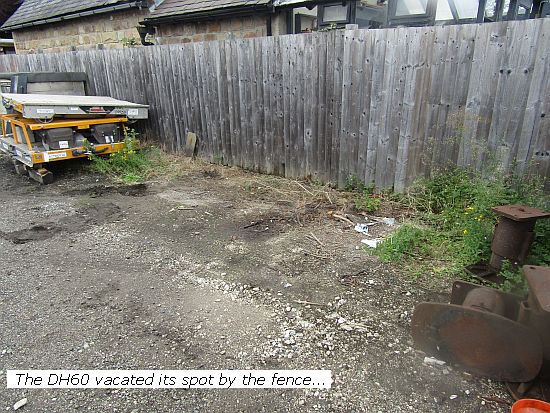
With Andy having departed, I spent a happy hour gradually extracting the minilok from its parking place by the fence (it had been craned in there) if only so that our neighbour could get to the roof of his outbuilding that needed repair: several slates had ended their working lives falling on to the minilok.

Some weeks ago I was contracted to collect an unusual Planet loco from the Cholsey & Wallingford Railway. Unusual in that Planets - the firm of F C Hibberd - made few rod drive locomotives, preferring chain drives. I did at one time - maybe rather unfairly - suggest that Hibberds were 'born copiers'. Their predecessor company, Kent Construction, got into the rail business rebuilding s/h Simplex locos after the first World War and even called them Simplexes until Motor Rail intervened. Hibberds bought out Kent Construction and continued supplying reconditioned Simplexes (with parts emblazoned with 'Motor Rail' removed and replaced, like buffer blocks and sand-box lids) as well as building their own from scratch. Later they bought J & F Howard and built some Howard designs under their Planet brand. In 1934 they introduced a design with a casing pattern that looked vaguely like O&K and a two-speed gearbox which, like O&K locos, had a handwheel to engage the clutch for either gear. In 1938 they built a standard gauge 0-4-0DM with a Crossley 2-stroke engine and a Freeborn gearbox, but the gearbox was mounted at the front of the loco with a jackshaft driving back to the wheels through side rods, and the resultant loco looked like a Hudswell Clarke. During and after the war they built a few more, but the Freeborn transmission (of which I know nothing) apparently gave way to a 'conventional' epicyclic Wilson SE4 and a Vulcan-Sinclair fluid coupling. This was one of those, and had worked at Guinness in London.
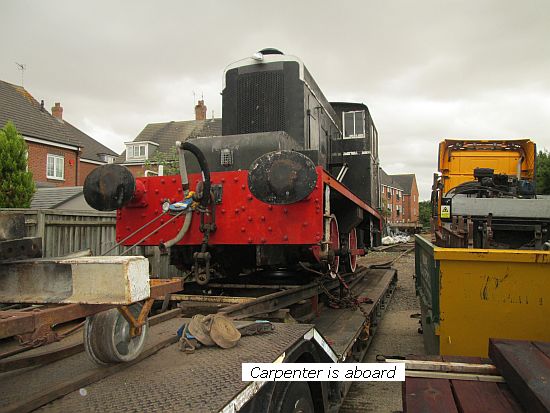
I often feel more comfortable if I have visited the railway before the low loader so as to assess whether there would be any issues with load or loading. In this case though I had ample pictures from the customer and had asked that they remove the derailer bars as they were going to ground the loco on the ramp. This turned out to be a bigger ask than I had realised, firstly because the derailers had not been off since the loco was built (and had fitted bolts into the frame members) and secondly because there were some self-contained ballast weights secured to the derailers. Once off, I was sent pictures and an anxious customer asked if he needed to send a separate HIAB lorry down to collect them. I assured him we'd have a go at sliding them from the p/way trolley on which they now resided across onto the low loader deck.
I got down to Wallingford well ahead of Jason who got delayed in the Towcester roadworks and had a minor contretemps with a motorist who tried to overtake him, realised that the lanes converged into one, dropped the mobile he was holding, braked hard and clipped the trailer with his wing mirror. Didn't hurt my trailer but the wing mirror bit the dust. While I only have Jason's version of all this, they pulled up after the roadworks and the motorist seemed to think it was entirely Jason's fault and he (Jason) was delaying him from getting to work. In the end he drove off and Jason reported the RTA to the Police, who told him to fill in an on-line form.
I meanwhile was having a minor crisis of my own. There was the loco on the loading pad, but the p/way trolley with the derailer beams and ballast weights was sat in front of it and trying to lift a beam had given me a new respect for the C&W personnel who had undone and extracted them. A casual question to a volunteer about 'where their forklift was garaged' brought forth the reply that he didn't think they had one. When the railway's engineer appeared he told us to keep the trolley as they had several so when Jason arrived we lined up, loaded said trolley and winched the loco up behind it. I had, incidentally, deployed the hoses as the site was so cramped that Jason couldn't get the unit to the back of the trailer. C&W offered to barrier it up with an 08 running A1A but as this was our first visit I wanted to show how capable we were. I was surprised though, at only 24tons (minus derailers and ballast weights) it gave us so much resistance that we snatch-blocked the winch rope.
I set off for home and had barely left Wallingford when I received a call from the aggrieved motorist who said that 'one of my drivers' had struck and damaged his car and he had eye-witnesses to prove it. He had presumably traced my number from the sticker on the back of the trailer as Jason's tractor carries his name. I politely told him what I understood had happened but as I only own the trailer an incident like this comes under the haulage contractor's insurance. After five minutes trying to brow-beat me he went off in a huff. I warned Jason to make sure he got his police report filed in case it went further!
The next morning I got to the Derwent Valley Railway at Murton earlier than I'd agreed with Jason only to find him sat there waiting, having been overnight just north of Leeds to get ahead of the Abnormal Load embargo that applies to West Yorks during rush hour. He had lined up and started to get set-up: if I had been there before him I might have positioned him slightly differently but I put a minor concern to the back of my mind and mucked in.
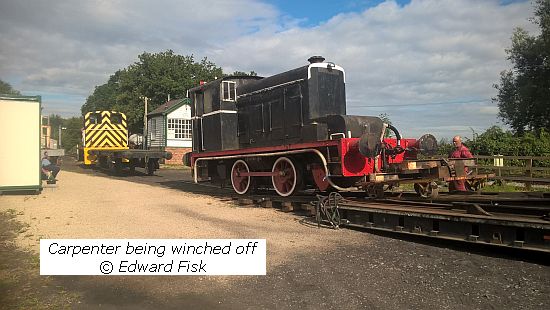
Normally when we unload we start paying out the winch cable and the loco obediently rolls down until the first set of wheels reach the permanent track and somewhere about then the gravity-assistance is equal to the rolling resistance and the loco stops. But just as it had been a p*g to get on, this Planet was now reluctant to get off and had to be assisted. My little concern now became real as the loco pushed the ramp slightly and mounted the rail head on one flange, but the 03 and barrier wagon were on a curve so after a moment there was a clunk as the wheel dropped in to the flangeway and all was well.

We packed away and had planned to head north for a load but at the last minute this had been deferred. The following Monday Andrew had me over to an auctioneers in Manchester for a load that included so many large bolts that I had taken the precaution of unloading even my toolbox to stay within weight. We unloaded it all that evening as the following day I was off again, another railway to visit for the first time for haulage. On this occasion a tank wagon was sat by the loco shed at Llangollen. Access is a little tight so Jason sailed past and turned at the Eisteddfod coach park and arrived from the other direction, and still had a tight call thanks to a carelessly parked car.

The load was sraightforward and he headed for Quorn. I cut across country - it was part of a route Steph and I used to do regularly when we went from Sheffield to Bala and it was pleasant to spot the changes and reminisce, though having to remember to keep to 20mph in built up areas was a pain. Anyway, in to Quorn where we were due to unload the tank wagon and reload a grampus. My quick calc had suggested it was going to be a long day, so Nick T at Quorn had planned it that we unloaded the tanker on to the turntable, at the other end of which was the grampus, turn the 'table and load the grampus. And it went very smoothly, we were in and away in just over an hour.


Next stop was Ruddington and I assumed that Jason would be taking much the same route Jeff had in the other direction, but no, as a lighter load he wasn't so restricted and as I came out of Loughborough I found he was ahead of me, stopping the traffic. Not intentionally, but the trailer had grounded on a hump-back bridge and he had to leap out and raise the neck! We got to Ruddington about 4pm: I knew where to unload and had been assured there were volunteers on site but I only found one, who having checked I was legit hid himself away in an office.

We unloaded and departed for home, getting stuck in Nottingham traffic. We are now up to the end of July, where I had a booking to shift an open wagon from the Churnet Valley to Northampton. The CVR was another railway I had not visited with my transport hat on and whilst I knew access was via Froghall, it took a while peering at Google Earth to realise the lane that was available. My direct route from Darley Dale got me so far then declared the road closed, so I took a diversion and still got there well before Jason, who had had one of those mornings when customers suddenly all want to talk to you. The wagon was sat waiting, it was a 13T open with MoD Asset Register stickers still on it. I remembered being at Bicester with Andrew on a disposals tender with a rake of half-a-dozen of these and some gentleman spouting on about how he was going to buy the lot and 'put them back on the network' as a freight train for hire. I presume he didn't.

Anyway it was loaded and we moved it across to Northampton, where our friends at Hunsbury Hill greeted us and barriered it off. (I had the hoses and yes, could have winched it, but, well, I couldn't be bothered). That weekend Andrew and I turned our attention to RS8, which had actually run out of fuel. We rectified that and then found it was low on transmission oil, caused by a bad leak from a heat exchanger joint which had blown out. The reason for this was that RS8 had been requested for the following weekend's gala event, with a schedule of movements (as station pilot, Rowsley) that spread over 5 pages of A4. Having satisfied ourselves that it ought to be OK, it moved up to Rowsley the following Thursday in between service train movements, and was parked over near the HST building.
On Friday we were trying to move the 'train' back on road 1 in order to get on with various things when the gearbox on the class 14 suddenly locked up and the loco became a 48ton sledge. Our first thought was to put it into neutral but having achieved this it would only move a foot or two backwards before locking its wheels and for myself, riding inside the cab, it was painfully obvious that something has come adrift inside and was locking the gears. I don't know exactly what, but Hunslet gearbox philosophy was to splash feed, i.e. lower down gears throw oil up to the ones higher up, and much is collected in trays to allow slow drain back to the bottom via important places. If one of these trays becomes detached - well we may open it up at some point in the future and find a mangled drip tray jammed in the gear train. There was nothing for it but to take the side rods off, and by the time that was achieved, it was time to put it back and go home.

Saturday the 9th, I was at Rowsley for a meeting at just after 8 a.m. Andrew had declared he would drive RS8 on Saturday and I could drive on Sunday but there as a 'team briefing' on the Saturday morning and I attended both for myself and on the assumption (correct) that Andrew wouldn't make it down that early. I watched it carry out its first shunting duty before leaving him to it and headed down to the shed.
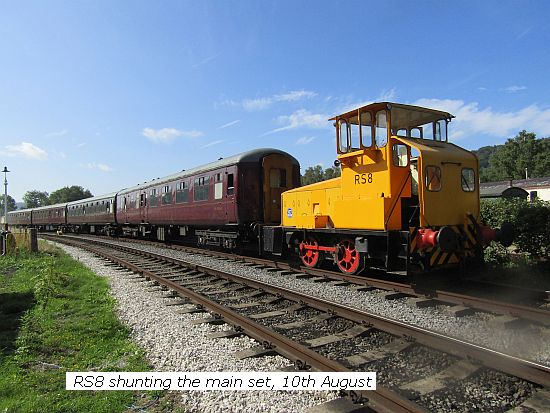
Andrew had the longer day (because certain moves late in the timetable were dropped on the Sunday) and RS8 performed without incident, save for the perennial warming of the drive axle boxes which we suspect is as much brought about by the exhaust gas discharge adjacent as anything else.

And all seemed OK on Sunday until mid-afternoon. I was approaching a rake of wagons up near the HST building when I knew all was not well. I was already aware that converter base pressure had dropped away (could it be low on oil again?) when I realised that main air pressure was dropping off. I shut down and went to look up front. Of the 3 belts that link the crankshaft, alternator and water pump, two were on but twisted, the third was completely off and had displaced the charge pump belt. But I was only 20 yards away from the van so armed with suitable adjustable spanners I set about getting them back on, becoming aware that the belts must have stretched and I was at the very limit of the adjustment at the alternator. With luck, I thought, they'd survive but I needed to be a little careful. I had so reassured myself when I realised that both the compressor belts were off as well. The compressor mounts on a pivotted bracket and a bolt goes through a slot to clamp it to tension, but the bolt is a special and as we hadn't had one back at Tunstead, we'd put in a piece of 12mm studding with a nut at each end. More finicky, but it had worked OK for 5 years and only now decided to give an issue, presumably as these belts too had stretched after a full day and a bit of continuous work.

Later in the afternoon I had visitors in the cab when I knew we had a problem as once again the air pressure wouldn't climb. Yes the compressor belts were free as the compressor had dropped down on its mounts. The studding I found had stripped the thread at one end and the remainder was too short to get a grip. 'Cathryn' the HC 0-6-0T, was now waiting for its train with the GM at the throttle so I was desperate not to let myself down with RS8 failing. Turning around for inspiration I saw a wheel scotch on the running board so lifted the compressor and forced it in. It held long enough to get the shunt done and the PIC decided that there was nothing more and we could pack up. I parked RS8 up with relief.

And the outcome? The gala event was a success, helped by the guest loco in the shape of the LNW coal tank. Even RS8 got coverage in certain places, though a photo similar to mine (above) on Farcebook got someone incensed that we had 'used a diesel on a steam gala' even if it had once been a steamer. I think it was explained to him that it was only on ECS, not an actual passenger train. Little did he know that all the time 873 was doing 'Driver for a Fiver' from the loco shed.

I had some Safety Scotches to deliver to Litchurch Lane on Monday, so while I certainly wasn't going to attend the 'Great Gathering' (that sort of event is just not my cup of tea) I was able to see the continued work of returning the place to normal. Allelys were in, blocking the exit on the one way system (I went out following a UPS van the wrong way) and I passed where we loaded the two 08s back in 2021 - how time flies.
Friday Andrew wanted me to take a couple of gas bottles down to Twiggs for exchange but then he had a text from Mark S to the effect that 873 (aka John Boy or Bagnall the Barclay) had a brake cylinder failure and what were we going to do about it? I guessed the cylinder would be Knorr-Bremse (I knew much of the air system was as it was built for BAOR operation in Germany) but not what size, Andrew dashed up to Rowsley to check and found it was indeed K-B and a 12 inch size. A couple of years ago I had overhauled one of ours for a customer as a loan unit while he had his in to me for repair (his was severely pitted and after several fruitless weeks trying to identify a part number for a replacement- not helped by it being a Laycock-Knorr, (i.e. K-B but built under licence in the UK) I gave up and repaired his. My cylinder had eventually returned and being servicable, we loaded it up returned to Rowsley and swapped it for the leaking one: delayed only by the push rod eye needing to be eased slightly to get the pin through onto the weighshaft arm.
On Saturday I stripped the old one down - it wasn't as bad as I feared it might be at 60 years old, and initially it seemed as though the piston seal was merely worn on one face (where the weight of the piston bore down on it) until I examined it more closely after dismantling and found the rubber had parted company with the stiffening steel disc part way round. Today I spent some time cleaning some dirt and minor pitting out from the barrel as much as I could before greasing it up and reassembling the piston with a new seal and setting it up for air test. You cannot raise the cylinder beyond 3 or 4 psi as this is all that's required to move the piston against its return spring, so you need a pressure gauge whose scale only goes to 50 or 60 psi in order to see what the thing is doing. Is it holding pressure adequately? For my money it passes as satisfactory and will go back on to 873 to replace the loco's other one, which Andrew could hear was leaking when he was testing our replacement.
And that about brings you up to date., I will try not to leave it so long before the next edition, but if you are still calling in to check, I'll bid adieu and until next time - see ya then.