
Of Men at work (and tea)
25th May 2025

Monday morning was almost a deja vu - off to the profilers to collect some more bits, but this time it was for some plates Andrew had asked for, part of his 'kit' to extend the rear of my trailer slightly so as to be able to load something the length of a Pacer. (For newer readers, two or three years ago, unbeknown, my CAD trailer drawing had an error in it. So when I superimposed a Pacer thereon, it fitted. In Bristol, with the real thing, it didn't. Not by much (it wasn't a big error) but enough. The drawing was duly corrected, and everything I have plotted since has also fitted in real life. Er touch wood.)
Anyway, in the afternoon Andrew had a bit of free time along with Jordan and Clayton so the beginnings of a massive re-arrangement began, the main purpose of which is to get fencing materials relocated nearer to where they will - soon we hope - be erected and away from the front of the site where they have been deposited. Additionally J & C have been involved in general tidying which has improved the frontage somewhat.
Ever since we have been at Darley Dale there has been the remains of a car tyre sticking out of the earth near the oil store. Early on this week, as part of general undergrowth and sundries clearance, they started to dig it out. Except it wasn't 'just a tyre', it turned out to have a wheel in the middle, and the wheel had a piece of angle iron and attached to the angle iron - a men at work sign. So here it is (above) having spent at least ten years buried.
Tuesday and I was on the road early. Our plan was to get to Ludborough (Lincs Wolds Railway) for about 9 a.m. to collect an old 88DS Ruston. Back in my YEC days, I had been awarded a contract to hire a loco - the one we now know as Charlie - to Tioxide at Grimsby as their loco fleet (2 Ruston 165s and this 88DS) were in a parlous state. Tioxide's network had contracted - the loco shed was no longer connected to the active part of the rail system(!) and Charlie was almost delivered there as it was thought to be the unloading point. Anyway, once on site all three Rustons were donated to the LWR, and the old 88DS at a mere 17tons, was pretty much untouched, save that it probably didn't have as many holes in the cab roof as it has today.
But I digress. I had been assured that the loco would be shunted out first thing and so if we got there for about 9am, that would mean by the time we had set up and built the ramp, it should be sat waiting for us to winch aboard. So I reckoned loaded and away by 11 o'clock putting us into Telford for about 3pm - which had the added benefit that the hottest part of the day would be while we were travelling.

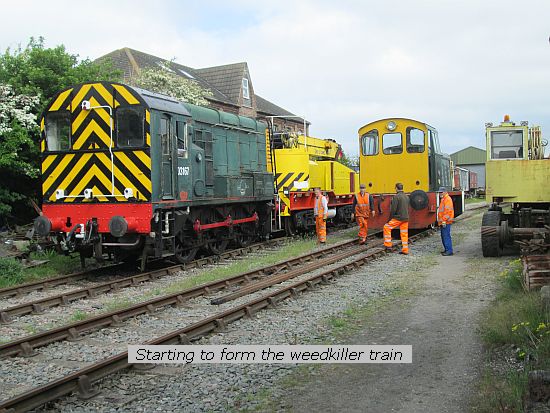
Unfortunately it didn't quite work out like that. When we arrived, the coaches had indeed been shunted out of the platform road but volunteers were intent on making up a weedkilling train which was allegedly 'due out at 09.00' (so already late and not yet formed up). Jason and I could at least make use of the time to re-mount the control valve on the trailer through the base plate I had made up in the hope of preventing any repetition of the cracked casing. It was 11 before the weedkilling train left, propelled by the Bagnall 0-6-0DM in the picture and once resident at Scunthorpe (AFR).

A few minutes later we were allowed to set up the trailer, and of course the day is now at its hottest. Even then the loco wasn't made available. To extract it from its siding required a shunt involving two locos: one of them (the 08) was sat in the platform, and as the other was down the line weedkilling, that meant starting up a Ruston 165 which, from the odd comment we gleaned, might have been problematic. It was well after noon before the 88DS finally advanced towards us and by then the Bagnall was back, having expended its weedkiller, and had to stop at an appropriate distance until we could get finished and clear the track. The loco was loaded, secured, the ramp dismantled and stowed and we hit the road about a quarter past one.
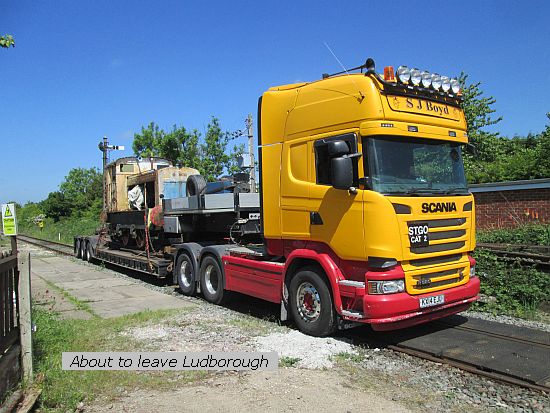
I was of course warning my customer in Telford, who had been expecting a loco at 3-3.30, that it would now be much later. In the end, I made it, cross country - for half five and Jason, having taken the more circuitous route north to Grimsby and along the motorways, about twenty minutes later. I hope the 88DS enjoyed the ride - it was probably its first ever experience of life outside Lincolnshire. By ten past seven I was booking a hotel farther south and Jason had his eyes on a lorry park at Upton-on-Severn.
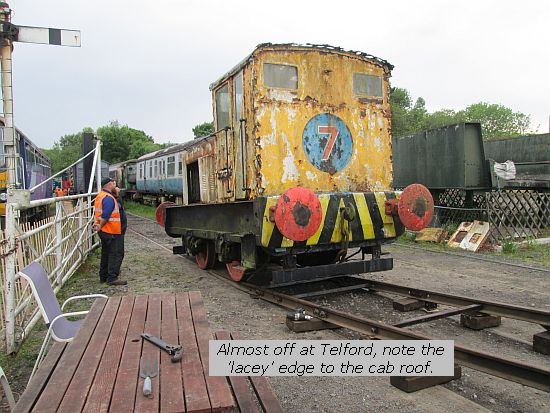
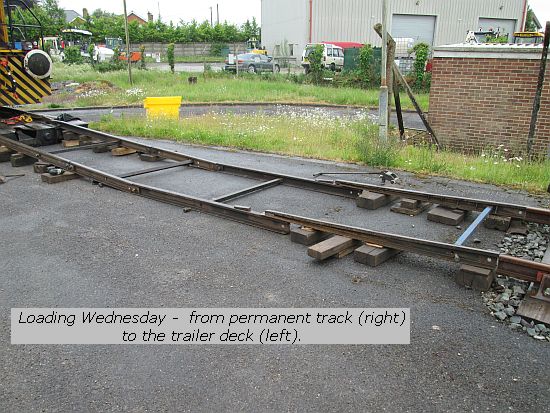
Wednesday, and I'm out of the hotel by 07.00 armed with a breakfast in a cardboard box. We're due at the next job at 08.00 and I'm there in good time, to be met with an apology that they cannot offer me a tea as they have forgotten to bring any milk. It isn't important as it is actually raining. Jason arrives and we line up. This is one of those less straightforward jobs where we must line up with a length of track which is well above the surrounding ground and worse still, there are no fishplate holes in the rail ends. We carry some 23ft of track on the deck in rails, but even the 6 x 2 can't quite get in and out in that gap and we're actually some 29ft from rail ends to deck. So the fabricated tip sections are turned around and span the gap, dropping the loco onto our rails, but for safety's sake I keep the locos's brake on so that movement is pretty much under winch control. We did the same thing collecting locos from CTRL and it is safe and practical, though a little more time consuming.
Either way we are on our way by 10.30, arrived at the destination by 2 o'clock, discharged and heading home by half-three. When I got home I went through a wadge of emails and found one from a transport company that they would be collecting that export consignment 'on Thursday'. I went to bed planning that first thing Thursday I must find out what time they envisaged.
I was half way through my porridge when my phone rang with a strange number. Yes, it was the transport's driver, who had been given my number though not the map giving him directions of where to be. But he was in the right place and had a small truck with a tail lift, otherwise we'd have been half an hour moving the train away along Track 1, followed by the big minilok in order to get the forklift out from the shed. As it was, his deck was already almost full up, his pallet truck didn't take kindly to the stony earth of the entrance road nor the transition to the tail lift platform. He was not having a good day, but I pointed him in the direction of Belper and wished him all the luck I could spare.
Friday, at about ten past two I discovered that Andrew had forgotten to collect the freshly machined plate for the water pump on Davis' Barclay so I dashed up and collected it just before they closed for the weekend. In the evening it was the Peak Railway Association AGM so I dutifully attended. Again, newer readers may not be aware that in 2014 I stood for a Board post, was elected against Mrs Statham's wishes, and the Rules subsequently changed so as to make it virtually impossible. (As she later said to me, loudly and with her face barely six inches from mine 'You only get on this Board by invitation, who invited YOU?'. Both the PRA and PLC have been in the habit of co-opting anyone whose face fits and merely getting members to ratify their status at the next AGM. Indeed, at least once a director has been co-opted at the first Board meeting after an AGM, suggesting that the intention pre-dated the AGM but was kept from the members.
I was hoping such practices might have died with Mrs Statham but the 2024 PRA AGM was asked to ratify the co-option of a new Director. I raised the matter then, and the minutes state 'and asked if there was any intention to Co-opt anyone onto the board. The chairman stated that there was no intention...' yet here we were at the 2025 AGM voting to ratify the co-option of another new Director. The Chairman stated that no other nominations had been received as if this in some way absolved them. To my mind, the correct practice, if someone is felt to be a valuable new addition, would be to invite them to attend board meetings (where they might not vote but could contribute) and put them up for election at the next AGM, even if they were then nominated and seconded by Directors. This practice of co-opting works on the assumption that the members cannot think for themselves and will only do what they're told. I felt more than a little disenchanted and was first out as the meeting finished. (I say this having served on a railway supporters group in various roles as well as having been a company director. It is, in my view, bad practice.)
Saturday. Andrew is here for the day but that is mainly because he has an aquaintance calling to collect some bits. Since some of these are heavy it needs the forklift, so Louise is fired up to draw the train forward and I follow behind in the big minilok. Roughly on time he arrives with his young son and an (older) friend in tow. First round of tea consumed and we get on with sorting out the remaining parts. Part way through the afternoon I am volunteered to get the 03 into action so shunt RS8, Hatramm and Pluto forward and we shuffle up and down a few times so each gets a turn. As they are familiar with the 03 at Crewe Heritage they are impressed at how smooth ours is at starting off and accelerating, and afterwards I open up the casing doors for a fuller inspection. By the time they have left (probably quite a bit later than even they had envisaged) we had consumed no less than three rounds of tea - something exceptional by our visitor standards - and it is really getting too late to begin anything serious.
Sunday. Alone again. First job was to cut out a new gasket for the water pump . That completed I moved to the little minilok, which the men from Deutz have been chasing me for a verdict on. To recap, I had checked that the output from my ramp generator was working within the specified voltage range but when I started the engine up it ran to full revs and showed no sign of control, with the 'fault' light remaining lit on the driver's desk. But the Deutz men had sent me a video which, they insisted, showed it working 'on the bench', with a potentiometer across the 5Volt output of the ECU, whereas my control signal was only between OV and the variable middle. To prove this once and for all I had ordered another footpedal, the same as I had employed with the big minilok (albeit a different system) and this had arrived earlier in the week. Before cabling it in I checked that the Deutz ECU was delivering 5V (and thus confirming that I had the right pins in the plug!) and then the moment came when I cranked the engine and - same as before. Straight up to full revs, the Fault light still on in the desk. I dashed back to the engine bay (the footpedal control was there and should be at idle) and pumped it up and down in the hope that the ECU might take notice, and when it didn't pushed my screwdriver into the engine to close the fuel rack. The engine stopped. I drafted a text to the Deutz man (over a tea) and will probably re-confirm it in an email in the morning.
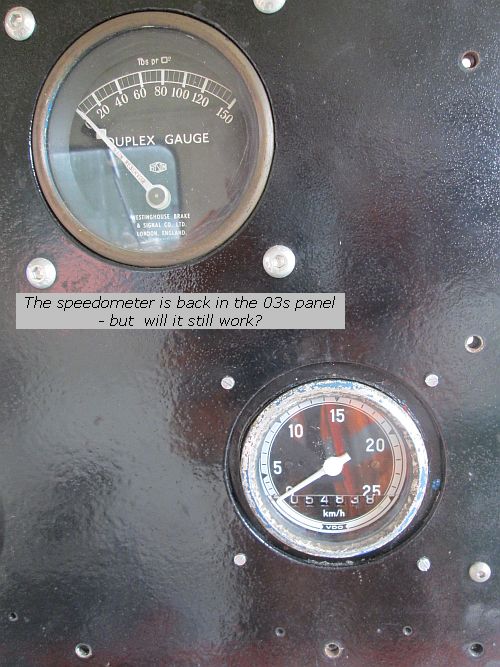
I returned to the 03, removed the plate that was fitted to hold the speedometer and took it into the workshops, easing the hole with a large half-round file until the speedo head slid in despite the layer of insulating tape wrapped around it. I then checked that there was no electrical contact between the speedo head and the plate to circumvent the insulated return status of the loco, before reassembling the whole thing and cabling it up. I haven't tested it yet - it was so far as we know working before I first dismantled it a decade ago, and I still have reservations since in theory we could drive in excess of its full scale reading, (it could in its original incarnation in Belgium but whether it was ever driven that fast is another matter). It might no longer function, it might do as a stop gap but might be another guinea pig for a further piece of electronics.
The rearmost buffers on the ferry van are continental pattern and have a big square hole in the faceplate. Since it is never coupled to anything they are exposed and a few years ago the left one was home to a family of sparrows. This year it seems as though a colony of bees has taken up residence. I am no wildlife photographer (you can tell, can't you?) but managed to snap a couple on 'final approach'.


It was mildly amusing on Saturday - the minilok had returned to its usual position but the ferry van was not yet shunted back, and half a dozen bees flew around the front buffer of the minilok as if saying 'we know our home should be just in front of this - where has it gone?' We are leaving a greater than usual gap so as to walk through without aggravating them.
Back to the workshops tomorrow, but as for the next few days there's a couple of gronks waiting for Jeff and me to take them somewhere new. As for the rest, well, as usual, it'll all be here same time next week. See ya then.