
Of Lifeguards and Motorway closures
8th June 2025
.... and I'm not talking Baywatch.
Monday, as I said was a domestic run-about but left me a little fatigued on my return. Tuesday however was back to what sometimes passes for normal and I was off to Celsa to uplift the last gronk at the steelworks. Although I had requested that they waive the 6pm loading restriction there was insufficient time to get approval and so we reached Cardiff at much the usual early evening, but instead of waiting patiently for the dot of 6pm started setting up almost as soon as we arrived.
Every gronk has lifeguards, which for the uninitiated, are steel protusions bolted to and projecting down from the frame members such that they pass a few inches above the rails and are intended to push aside any objects they encounter. They are akin to cow-catchers but it would be too late for any cow that got that far. As built, the bottom of these things are shaped in a semi-circle but (fortunately) a significant percentage have been cut off short over the years. Nonetheless we normally ask that they are either removed or at least slackened off before transit. (If the bolts are backed off the lifeguards will move aside if they encounter anything, like our rails.)
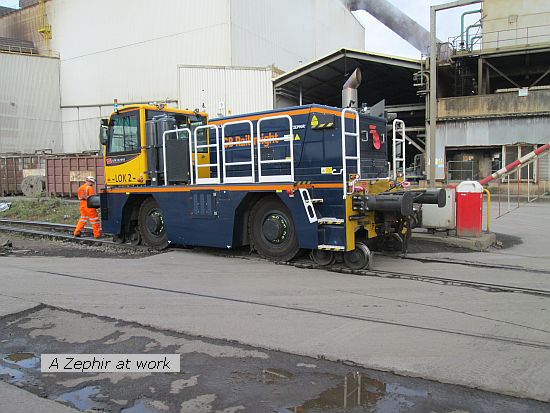
The loco we uplifted last week had had that done and was no trouble. I kicked the lifeguards on this one and to my dismay, they were solid. The rear ones had been cut short and I thought, with luck, they wouldn't be a problem, but the fronts would need watching. (If you are mystified, their rail clearance is acceptable for good condition track - main line standards you might say - but in poorer sidings, or derailments, they can prove too close. In our case, the angle encountered in coming on to our ramp is more than their designers ever anticipated, and they are well in front of the wheels they are meant to protect.) While we were working a Zephir appeared and we stopped to stand in a place of safety as bogie bolster wagons carrying hot steel bars passed by. So here's a better picture of one than I could get last time.
The ramp was completed, the winch cable hooked on and we started pulling the loco towards us and the ramp. The leading lifeguards actually gave no problem, and I was thinking it was going to be OK when Jeff signalled to stop. One rear lifeguard was gouging a groove through the concrete. I carry an extra socket on the trailer specifically for releasing 08 lifeguard fixing bolts if required. You can't get the impact gun on the nut on the inside, and steps can obstruct you getting to the heads too, but this way we managed to proceed with winching. The second time Jeff signalled to stop it as rather academic as I knew something was wrong as the winch had reached its limit. Sadly the other lifeguard was firmly wedged on the first rail of the ramp, and no amount of work by the impact wrench could release the bolts, as several tons of loco sat upon them.
Fortunately it was pinned to one of the 5ft rails of the ramp, and the rear axle had left that and was on the next rail, so we unbolted the 5fter and hammered it out from underneath the lifeguard. The loading proceeded without further issue, but thus had added time so instead of being on the road by 7.30 or quarter to 8, it was about twenty past as we left Celsa for the very last time (?).
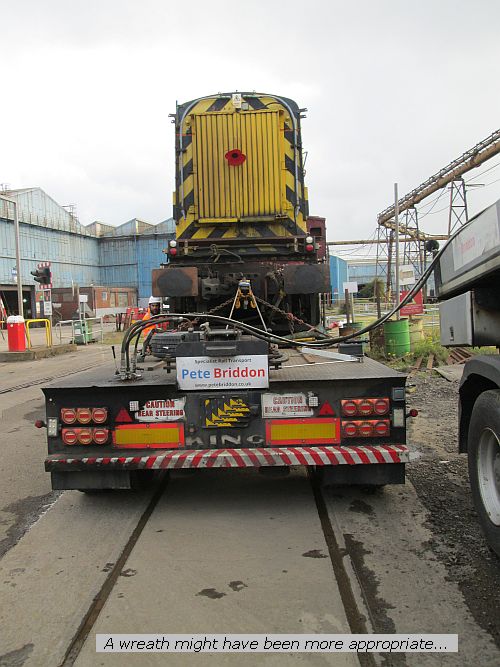
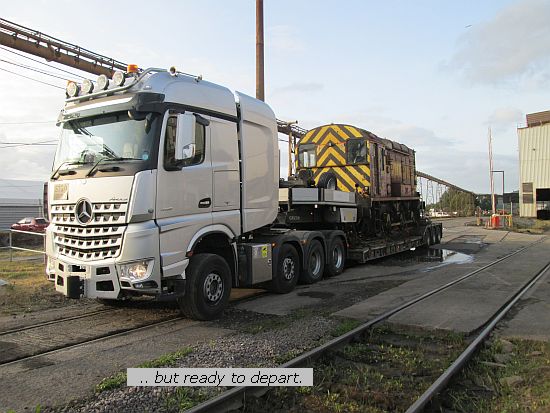
Jeff pushed on along the M4 and up the M5, overnighting in the M42 services just south of Birmingham. I was looking forward to my bed back at the Country Pile, and had it not been for the lifeguard delays I would have been at least 20 minutes earlier. As it was I got to the A41 (Solihull) turn just as they closed the motorway at 10pm. Three lanes of traffic funnelled into one and queued on to the 'signposted diversion'. In the next 30 minutes I travelled barely 400 yards. I had plenty of opportunity to consult my roadmap and AA Roadwatch and concluded that if I could make it to the next turning, a B road right would take me through a village, then left at a roundabout and a second roundabout showed a slip road to an A road that would take me to the next M42 junction (the A45) after which it was back to normal.
Another 10 minutes or so and I turned right, leaving the lorries in their endless queue. I cruised to the second roundabout, where to my fury the slip road which the AA showed as open was blocked off with barriers and a contractors pick-up truck. Pushing on, I came to a tee junction and thought that left was taking me in the right general direction (north-ish). It was, but a junction further on had a dead-end sign on one and a temporary yellow sign declaring 'No access to A45 or NEC' on the other. I turned back, nowhere to stop and consult my maps for fresh inspiration, I eventually found myself back at another exit road from the roundabout with the closed off slip road.
But look, there were a string of cars and lorries heading north as I had done. In these circumstances, when you're tired and in a strange area, you tend to assume that someone knows the roads better than you do and if that someone is in sufficient numbers and includes lorries, well, they can't all be lost, can they? So I dropped in behind them, back up to the junction, then to the one with the temporary yellow sign, which they drove straight past. Clearly they knew that the sign was a decoy and you could get to the A45 this way, I concluded. A few hundred yards later, we all stopped, and a minute or two after that, a guy in green hivi, whom I suspect was the leading lorry driver, walked back signalling us all to turn around.
I had now an alternative idea in mind. Working my way back to the first roundabout, I swung left, through Hampton in Arden and found my way to the A452 and from it to the A45, arriving at the M42 junction from the Coventry side rather than the Brum one, a mere one hour and forty minutes after joining the queue coming off the M42 a couple of miles south. And so, thanks to secure lifeguards, I got home at 1 am Wednesday morning instead of half-eleven Tuesday night.
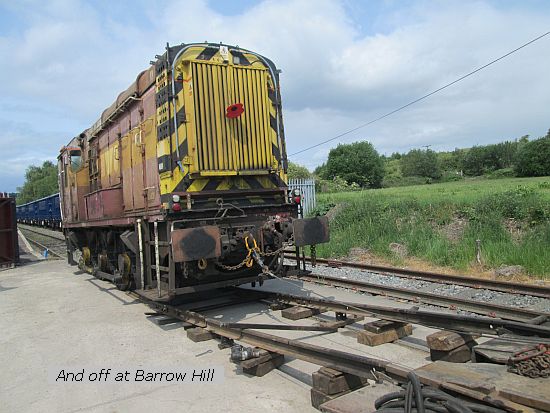
Wednesday - Jeff predicted 11.30 at Barrow Hill and was close to his estimate. We unloaded the loco and waved it goodbye. Nothing much to report on the rest of Wednesday nor Thursday, as I dealt with paperwork and phone calls. Friday afternoon however, as the rail industry shuts down for the weekend, I headed down to the shed and was joined later by Andrew. Between us we made a start on the extension pieces for the trailer (referred to last week) and then turned to the Davis Barclay. With Andrew watching the engine, we cranked it a few times without success. He detached a spring from a throttle arm and on the next swing the engine started, but ran up to high rpm. Fortunately it responded to the key switch moved back to 'off'.
We had several goes with similar results when it occurred to me that I had turned off the battery master switch but the oil pressure light still indicated and my voltmeter monitoring the capacitor was at a steady 24Volts. The BIS was no longer functioning. I detached a battery cable and called it a day.
Saturday. No Andrew expected but the brief running had thrown up several fuel leaks on the Barclay. Two of them turned out to be hoses not fully tightened but the worst, around the torque converter temperature switch, required what fuel was in the circuit to be drained down. I had the parts out, re-sealed the threads with PTFE and screwed it all back tight. Alistair and his son popped in to check something on the '14. Apparently someone had criticised their gauge 3 Class 14 and they wanted to check and if neccessary correct the 3D print program to get it right. Meanwhile it runs well, sounds good and a gauge 1 version is in prospect. Oh, and while the thought is in my mind, check out the you-tube video [Here] from Telford Steam Railway which carries footage of me unloading the Ruston 88DS (I'm around the back of the trailer in orange ovvies - at one point I waved at the drone but that is where it has been editted).
Sunday and I got down just before Tony S. To my chagrin the fuel leak by the converter switch had resumed, but first Tony gave me a hand bolting up a replacement battery switch. I had dug one out of the stores the previous day, opened it up and cleaned the copper contacts and thought it probably OK to use. The battery switch on the Barclay is mounted on the cab back under the fuel tank, so it involves me squeezing in the rear compartment with fuel tank above and batteries below and to my right.
With a little time on my hands I went out to RS8 - there had been trouble starting it earlier in the week (Jordan and Clayton had been around) and in the light of my better knowledge I wondered just how big a capacitor I had put in, after all, it was only intended to maintain a feed to a timer relay.
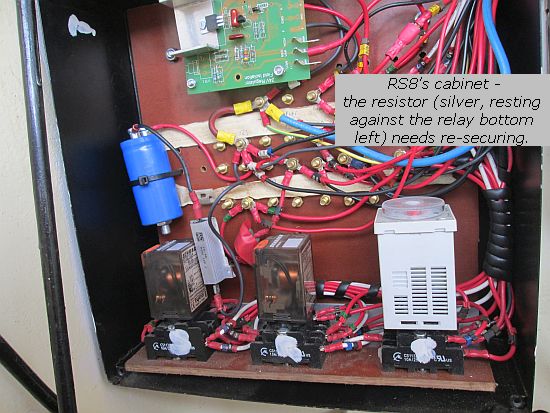
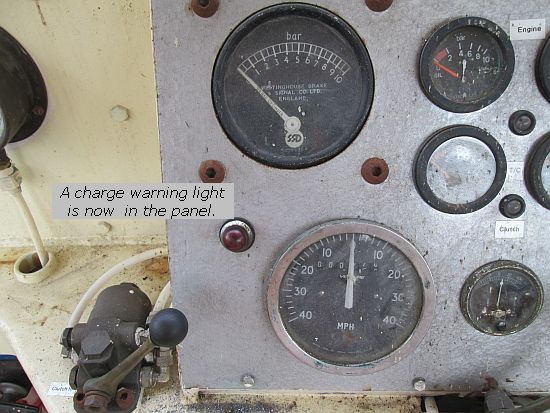
It transpired I had fitted 10,000mfd, but as I looked at the cabinet, apart from finding that the double-sided sticky tape no longer held the big resistor, it occurred to me that I never put in a warning light for the voltage regulator. So on a whim, I dug out a bulb holder, drilled a hole in the instrument panel, fitted said holder and wired it back to the cabinet. A quick test that it lit and I was back in the shed as Andrew arrived.
After cutting some wood for himself we took a look at the switch leak on the Barclay and concluded that the malleable reducing bush was sufficiently rough that the Dowty seal couldn't do its job, so I drained the pipework down again, while he found another bush and filed the top surface smooth. Hopefully this time it will stay dry, but when I tried to crank the engine, there were pops and bangs and sparks from one terminal on the battery switch I'd fitted. Andrew looked at the switch and recognised where it had been before and that it was not the finest example of its breed. I suspect it will be changed for another but it being half-five we called it a day.
Another early start in the morning, this week I've three locos to move and a load more gallivanting in prospect. Come back next week and see if I have had to negotiate lifeguards, road closures and dead ends once more. See ya then.