
Of capacitors and capacity
11th May 2025
Same lark, different colour scheme?
Oh, hello again. Is it Sunday already? I got a call a few days ago from our friends at Tanfield. It seems they had Lucie lined up to move with a local haulier but his trailer had received a bash and he could no longer do it. Did I have any capacity to move it this week? That put me in a bit of a spin. A phone call to Jeff confirmed what I already knew - he had a job that was taking him down to Devon and he wouldn't be unloading until Friday morning : scarcely time to return north, swap trailers, go to Pickering and on to Tanfield, not with driver's hours limits anyway. Moreover, back in HFS days Adam could have assigned a smaller (more economic) tractor to the job and sometimes recently I have been too expensive because I am costing using a tractor that is a bit overkill with locos or wagons that don't need a tractor rated to 150tons max. Avoiding this 'paying for excessive capacity' was one of the reasons I got into this lark in the first place (or maybe, it was just the 'angle' Andrew convinced me on, but who cares) and for some time we have been looking at an alternative haulier with whom to quote the smaller jobs when they come along. Andrew was in charge of establishing a relationship but this couldn't wait: I phoned direct and then sent an email.
Meanwhile Monday afternoon I was down at the shed. Jordan and Clayton were on site but I started implementing a minor re-wire on the Barclay. For simplicity (and to protect my warranty) the wiring incorporates a progammable relay and I approached this as I do for a full scale PLC. The problem with many PLCs though is that when you crank the engine, the batteries are working their hardest and the volts drop, the PLC supply may drop below a level where its internal electrics close down. But as the starter motor is engaged by the PLC, the result is the output switches off, the starter stops, the voltage recovers, the program re-starts and activates the starter, the starter engages, the volts drop, etc. In early YEC days we called this 'motor-boating' though why and what the relevance was is lost in the mists of time. The solution, proposed by the PLC suppliers, was to add a pair of 12V burglar alarm type batteries which powered the PLC but were fed through a diode from the loco's main system. Thus when the starter engaged, the PLC maintained its voltage thanks to the little batteries and they were protected from draining back into the rest of the loco by the diode, but when running normally, they received a charge from the loco's system which kept them topped up. There was a downside to this: the little batteries have a finite life, just like the loco's main ones, and if left for a long period of time, if the little batteries went flat, you wouldn't be able to start the loco as you were back to motor-boating. (We did advocate leaving the battery isolation switch on when charging the loco batteries, as your charger would then also charge the little ones through the diode, but you had a lot of other things 'on' as well. It wasn't ideal).
When I came to RS8 I had a similar sort of problem with a timer relay and instead of installing batteries, I thought what I needed was a capacitor that would charge itself when you switched on and then slowly discharge when the loco was cranking, and keep the timer relay powered for the duration. It worked, so I turned my attention to other PLC installations, but suitable big electrolytic capacitors can sometimes be hard to obtain and some of the bigger ones cost anywhere up to £50-60, still hardly any worse than a pair of batteries and installation.
The Barclay had a capacitor but when I cranked, the programmable relay turned off but unlike PLCs it didn't motor-boat, it just stayed off.I had a re-think. This installation wasn't a full PLC, the relay was primarily a protection against engine defects, or driver mis-use. e.g. accidentally cranking the engine when it is already running, known as 'plugging'. Instead of my driver signalling 'start' and allowing the electronics to decide to make it crank, why not give a straight through to the starter, but interpose a relay which could break that connection if required, e.g. if the clutch is already engaged or if the oil pressure is already there ('cos it's in operation). The same logic could be applied to the fuel solenoid but for now I'm sticking to the relay unit powering that if it is OK. So Monday was rerouting the feed to the starter motor through a normally-closed relay, which would have the effect of reducing the load though the programmable relay so that the capacitor might be able to cope. I got as far as testing, and it didn't.
Tuesday I was trying to get on top of some overdue admin when I got a phone call from Andrew asking if I could go down to the shed as his Land Rover was due in 20 minutes. I had little choice here, he was at work. Just after half-two a recovery truck arrived with a very beat up swb Series 3 Landy aboard, whose somewhat lopsided appearance was in part due to having 3 wheels of one size and a fourth rather smaller. It was duly winched down from the recovery vehicle and when Jordan and Clayton arrived, moved to a 'parking' position pending a start on stripping it down (a new chassis, engine and some front body panels being on the initial list). This is Andrew's second (well, second complete one, he had a chassis of another for a while). When I was at Locotec I brokered his purchase of an old RMS Lwb Defender - one of the early versions with a 2.25 litre normally aspirated engine. It was seriously underpowered for the lwb marque (like 0-60 in about half an hour) and we changed it for a 2.5 litre turbo. In the end the front bulkhead developed holes that sent spray up your trouser leg on wet roads and he sold it to an American who was touring the UK with a wad of cash buying Land Rovers. Anyway, years later here he is, in a house that is somewhat high in the Peak hills and subject to icy roads in winter, so a Land Rover is back on the essentials list.
Our hoped for new haulier came back and said that try as he might he couldn't get Friday free to move this loco. A few minutes later, as I collected my thoughts as to how to break the news to Tanfield they rang me. I had barely finished the call when it all changed. Our new man had had the Friday job postponed, and anyway he wanted to be in Newcastle for a stag do Friday so this would fit nicely. The news was passed back, and the neccessary paperwork and notifications put out.
Wednesday - still hadn't finished admin so got that wrapped up, and then took the batteries for 873 back to it and passed the loaned ones back to the loco they belonged to. I checked the tension on the alternator belts and instead found a coolant drip on to my nice new alternator. Nipped up hose clips.
Thursday I had a spring to go out for repair, and once that had been done returned to the shed to get the van loaded with the bits for Friday. Friday and at ten to eight I was at the yard. The old Merc tractor was sat there as Jeff was out in the new, but a different Scania was waiting to hook up to T1. In fifteen minutes we were off. I got to Pickering a little before ten and introduced myself. Lucie the Cockerill tram loco was sat waiting along with an 08 and a pair of plate wagons which I gathered they expected to use as barriers. I wasn't in favour as although we do use barrier load/unloads at a couple of locations there is no doubt that winch-loading, though slower, is more controllable. Anyway, Jason (for he's the driver) arrived just before 10.30, we turned around in the yard and lined up, I set too to build the ramp (and instruct) the gronk pushed the loco to us and we took over.
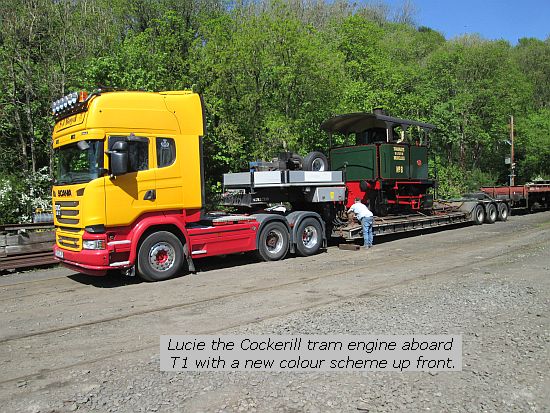
I had a bit of trepidation here. After all, last time I was out with the trailer the control valve had 'died', so this was a brand new one but not proven. I knew that I would need to adjust the relief valve but Andrew had looked at the broken one and suggested that its failure was due to it being bolted to chequer plate - there had been stresses through the uneven surface. I didn't see why it had survived for so long if that was the case, or why it failed not when puling a loco on but as we were about to roll a loco off. Either way the pipework wasn't full so when the donkey fired up and I pulled the lever nothing much happened. Eventually I could hear groaning noises as oil and air passed through the hoses and motor and it began to pick up speed. Sure enough after a few feet and the loco started to climb, the winch stopped and I hunted out a spanner to screw the relief valve down a bit. Properly this should be done with a gauge on the test point I put on the system, but despite a long search I had failed to find my test gauge, so had to go on a hit-and-miss which meant listening to the Lister driving the pump and worrying about whether this valve was about to crack open like the last one...
Lucie was aboard and chained down and we were on our way just after noon. The loco took the roundabout but smoother route back down the A64 and up the A1, while I headed due east and got to Tanfield a little after two. Introducing myself as the ''advanced guard' to a member who insisted that he had only 'dropped in for a cup of tea' but stayed because 'we were due at half-twelve'. I had hoped to be there by half-two but never any earlier so I felt a trifle peeved, but accepted a cup of tea to restore my self-esteem. Jason rolled up at about three, we lined up and unloaded, the loco, being only 19tons and with small wheels, taking a dislike to one of my ramp-rail joints which another loco would have ridden over.
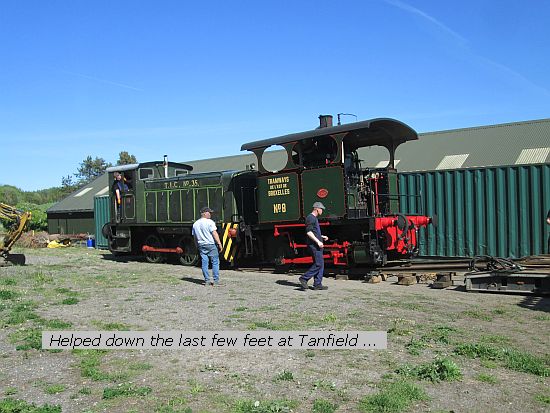
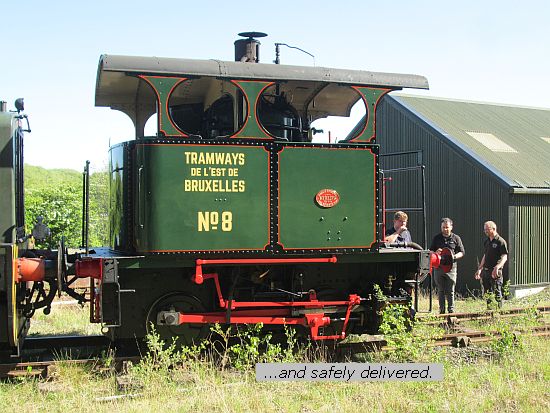
The familiar Ruston 165 was able to couple to it by now and pulled it gently down the last few feet. Paul Middleton ("Piglet") had arrived and was wasting no time getting a fire lit (we had discussed before we left Pickering that it still had its boiler full even if the tanks were half-empty) and there was film of it in action before I had got home. Jason went on to Newcastle and his stag do.
Saturday. I had arranged for a visitor to turn up at 10.00 so hung around with the Blockman waiting for him to show up, but he didn't so after half an hour I got back to work. First job of the day was to manufacture a new connection box for the alternator wires on the Barclay. My original installation proving a bit iffy, it will be relocated on the other side of the loco and the existing cables will not reach the extra distance, so a box to joint them to new cables was needed and that there were no unprotected live wires before I did more testing. But the 25mm hole cutter could not be found and in the end I used a 22mm and filed out the plastic until the conduit end fitted. Some suitable terminals were mounted inside and the cables made off temporarily for safety.
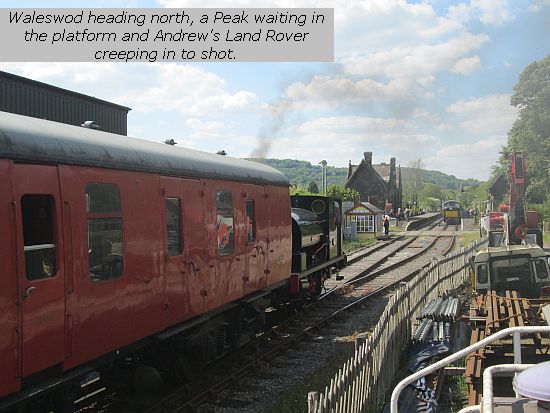
It was a mini 'Twin Peaks' event, with 'Great Gable' out with 'Penyghent' and there were a fair few enthusiasts on the trains. On my own (again) it occurred to me that the 03 hadn't had much of a test run to check all those mods I had been doing... I pushed RS8, the Hatramm and Pluto up to the end of the headshunt and then shuffled up and down with the 03. At one point, Great Gibble -sorry Gable - was brought to a stop by the home with the last two carriages stationary alongside the south end of the yard. Our rules say that when a train is coming past our movements must stop, but this had already passed and wasn't moving so I could continue my 'tests' up and down and of course cameras faced me. The gearbox was a little stiff but began to go into gear more easily as the test went on, otherwise everything was working like it should and from what I could see, there were no untoward leaks or any drips underneath.
Later that day, apart from making a baseplate for the control valve, I hooked up a moving coil voltmeter to the Barclay to see what the capacitor was doing. On powering up reaching full charge was almost instantaneous, which was surprising, but on cranking, it fell away to 16V and the programmable relay turned off.
Sunday. I spent the morning at home and only went down after lunch. The Deutz men wanted to know how I was getting on with the minilok. I had checked the output from my ramp generator but they wanted me to try with a potentiometer across their 3 wires. I had previously tested the stop solenoid and found it wasn't energising, and there I had left it. So first I took out the stop solenoid and then started the engine. I wasn't surprised that it went straight up to full revs and stayed there, so I shut it down (manually) and set about adding a third connector in to the plug so that I can rig a potentiometer on to it as they want. Back on the Barclay I wired a second capacitor in parallel with the first and tried again. The charge time was slightly longer, but the voltage on cranking dropped only to 18V and the relay unit stayed on. I have never approached the subject of determining the size of capacitor needed this methodically before: it is strangely interesting. Andrew arrived but with little opportunity to do much. I adjourned to the 03 and started to pull a cable through for a speedo. When it returned from Europe it came with a VDO speedo comprising a (3 phase?) generator on the gearbox and a speedo head calibrated 0-30km/hr. Since at full speed the 03 can now exceed this I didn't initially re-connect it but decided I would for entertainment and if it didn't work, come up with something else. Getting a cable through an existing flex conduit run was a bit of a fight (and revealed that rainwater resides in the lowest part!) but the cable was pulled through and made off at each end. Sadly the speedo head turned out to be earth return and the aperture in the instrument panel too tight to accept even a mere wrap of insulating tape around the body so must be eased a little more before wiring and testing.
And that's about it. Tomorrow I must head up and oversee the recovery of parts from T2 and their return to Darley Dale, the van is in for MoT Thursday and a trip down south on Friday. The trailer is returning to Jason's so he can make a mod to his Scania to suit T1's stinger but I haven't any jobs planned for this week. As for aything else, well, as usual, come back next week and find out. See ya then.